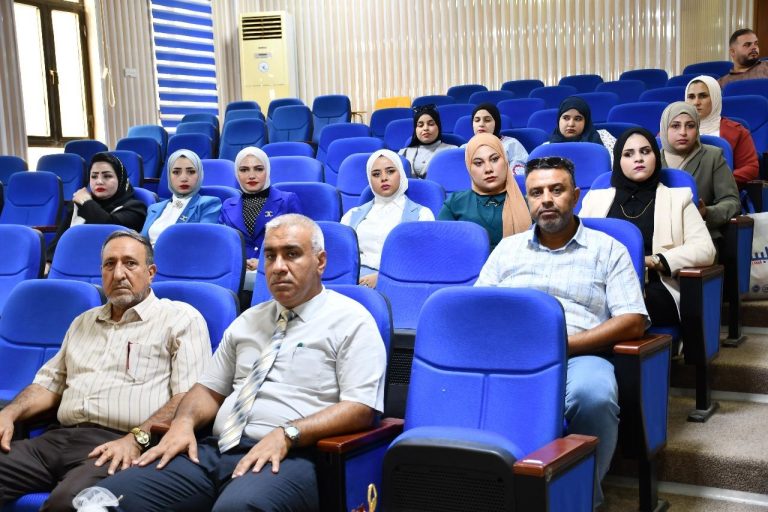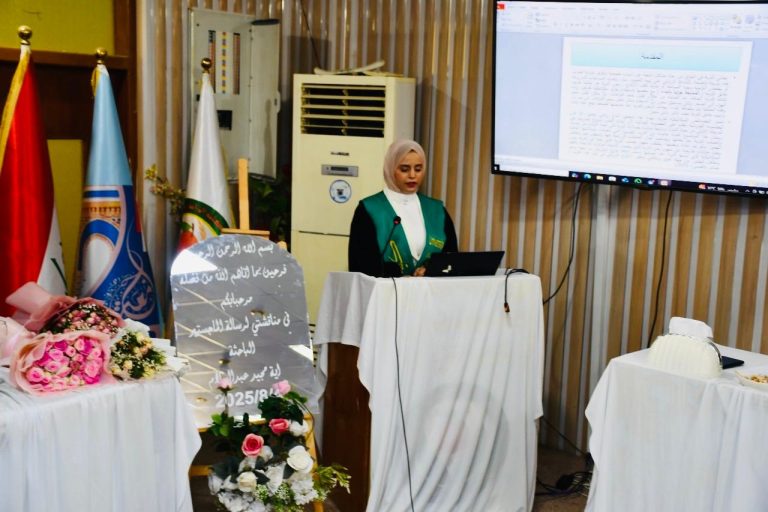
A Master’s Thesis at the College of Agriculture Examines the Effect of Compaction Levels and Types of Amendments on the Physical and Hydraulic Properties of Clay and Silty Soils.

The College of Agriculture at the University of Diyala Discussed a Master’s Thesis Entitled:
“The Effect of Compaction Levels and Types of Amendments on the Physical and Hydraulic Properties of Clay and Silty Soils.”
The study, presented by Aya Majid Abdulsalam, aimed to assess the impact of compaction on the physical properties of clay-silty soils. It also examined the effect of soil amendments on certain physical properties of the same soil type, as well as the influence of the interaction between compaction levels and the types of amendments on these properties.
The study arrived at several key conclusions, including:
-
Amended soils showed better results compared to unamended soils.
-
The addition of gum arabic led to an increase in saturated hydraulic conductivity, water retention capacity, nitrogen availability, and leachable ammonium from the soil.
-
The application of bentonite resulted in an increase in bulk density, soil penetration resistance, and moisture content.
-
Statistical comparisons between samples revealed significant differences between amended and unamended soils.
The study recommends:
-
Adopting gum arabic as the primary amendment to improve soil fertility and increase organic matter content.
-
Encouraging the use of treated organic materials to enhance organic matter content in the soil, which contributes to better soil structure and greater water retention capacity.
-
Implementing amendments that have proven effective in maintaining soil moisture during dry periods, thus promoting the sustainability of agricultural production.
-
Avoiding reliance on non-significant differences when evaluating amendments; rather, significant and statistically proven differences should be considered, alongside the long-term effectiveness of amendments.
-
Applying these amendments to various soil types and cultivating specific crops to test their effectiveness and impact on vegetative growth.