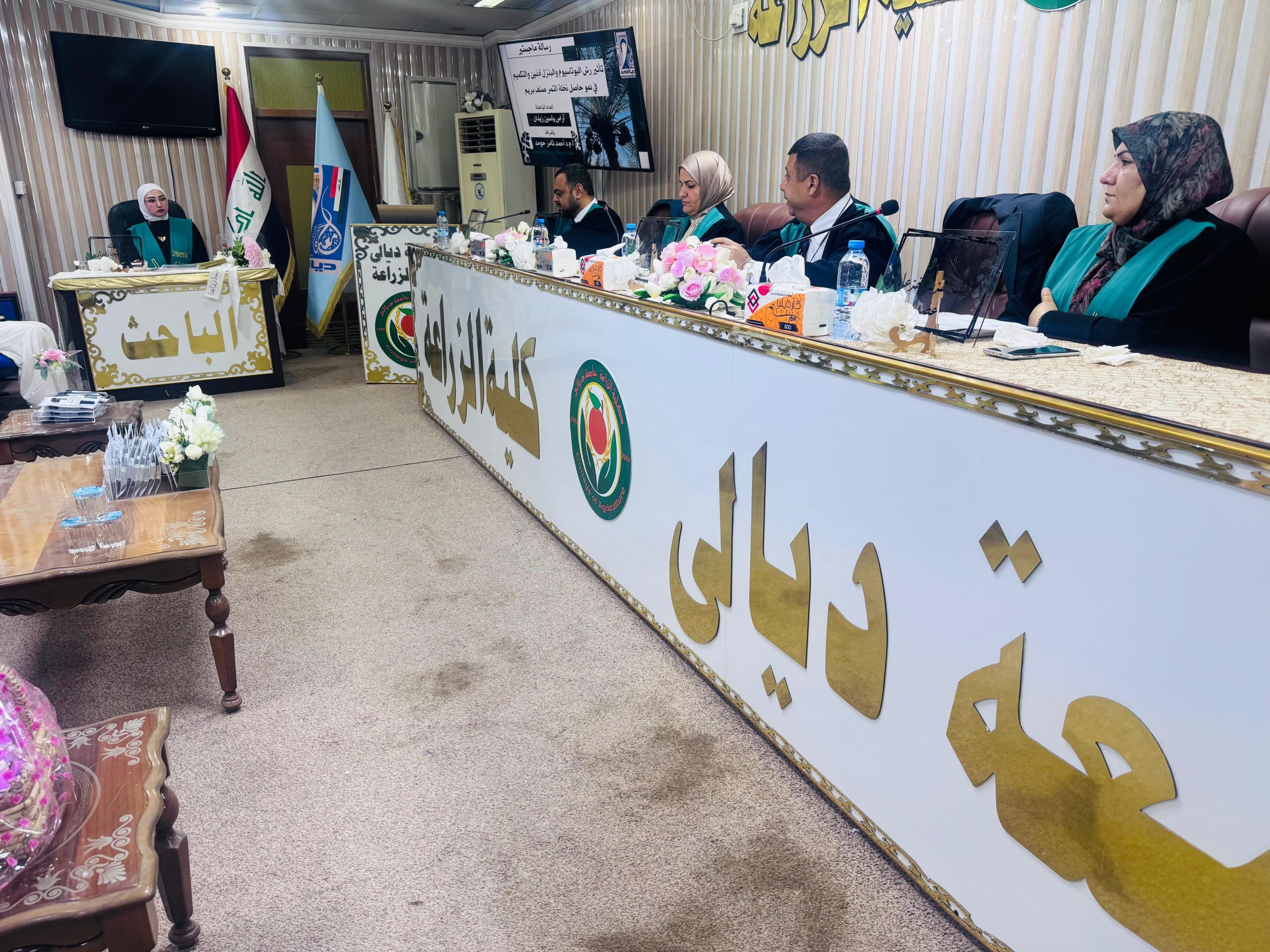
A Master’s thesis in the College of Agriculture examines the effects of potassium spraying, benzyladenine application, and bunch bagging on the growth and yield of the date palm (cv. Bream).

The College of Agriculture at the University of Diyala has discussed a Master’s thesis entitled “The Effect of Potassium Spraying, Benzyladenine Application, and Bunch Bagging on the Growth and Yield of Date Palm (cv. Bream).”
The study, submitted by the student Aras Yaseen Zaidan, aimed to determine the effect of potassium spraying, benzyladenine application, and bunch bagging on certain growth characteristics of date palm fruits (cv. Bream). The experiment comprised three factors: the first factor was potassium spraying at three concentrations (0, 100, and 200 g L⁻¹); the second factor was benzyladenine at two concentrations (50 and 100 mg L⁻¹); and the third factor involved bunch bagging (bagged and unbagged), with treatments applied in three sprays during the growing season.
The study reached several conclusions, most notably that bunch bagging (covering the fruit clusters) contributed to protecting the fruits from unfavorable environmental conditions and pests, which was positively reflected in fruit quality. Furthermore, the interaction treatment among potassium spraying, benzyladenine application, and bunch bagging resulted in statistically significant differences in all yield traits and physiological characteristics of date palm (cv. Bream).
The study recommends the application of benzyladenine at appropriate stages after pollination to increase fruit set and reduce fruit drop. It also suggests conducting further studies using different concentrations of potassium and benzyladenine, as well as on other date palm cultivars, to determine the most effective treatments.
#College_of_Agriculture_Our_Approach_is_Sustainability