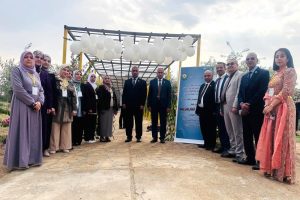
A Master’s thesis at the College of Agriculture examines the effect of foliar application of the antioxidants ascorbic acid and alpha-tocopherol, along with the addition of NPK compound fertilizer, on the growth and yield of turmeric (Curcuma longa L.).

A Master’s Thesis at the College of Agriculture Examines the Effect of Foliar Application of the Antioxidants Ascorbic Acid and Alpha-Tocopherol, along with the Addition of NPK Compound Fertilizer, on the Growth and Yield of Turmeric (Curcuma longa L.)
The College of Agriculture at the University of Diyala has examined a Master’s thesis entitled:
“The Effect of Foliar Application of the Antioxidants Ascorbic Acid and Alpha-Tocopherol and the Addition of NPK Compound Fertilizer on the Growth and Yield of Turmeric (Curcuma longa L.).”
The study, presented by graduate student Hajar Hussein Ali, aimed to explore the feasibility of introducing and cultivating turmeric in the central region of Iraq. It further sought to determine the optimal application rates of NPK compound fertilizer and to assess the use of certain antioxidants to mitigate the adverse effects of high temperatures and drought conditions typically encountered during the cultivation period.
The study yielded several significant findings, including the following:
-
The application of antioxidants had a statistically significant effect on vegetative growth characteristics, yield components, and biochemical traits. Specifically, the combination of alpha-tocopherol and ascorbic acid (VEC) produced superior results across most vegetative, yield, and biochemical parameters.
-
The NPK fertilizer also demonstrated a significant impact in enhancing vegetative growth, yield, and biochemical attributes. The application rate of 250 kg·ha⁻¹ was found to yield the most favorable outcomes across the majority of vegetative, productive, and biochemical traits.
-
Turmeric can be successfully cultivated in the central region of Iraq under similar experimental conditions, particularly when antioxidants are employed to alleviate the negative effects of heat and drought stress on plant growth and productivity.
The study recommends the following:
-
Turmeric cultivation is feasible and produces promising results for most vegetative, yield, and biochemical characteristics under the conditions tested.
-
The application of antioxidants—specifically, alpha-tocopherol at a concentration of 150 mg·L⁻¹ and ascorbic acid at the same concentration—is recommended due to their proven efficacy in enhancing vegetative growth, yield, and biochemical properties of turmeric.